Advertisement advertisements
The race to develop autonomous vehicles has been one of the most exciting technological battles in recent years.
Among the main competitors are Waymo and Tesla.
Both companies are at the forefront of this revolution, but with quite different approaches and strategies.
In this article, we'll explore the trajectories of Waymo and Tesla, their technological innovations, the key differences between them, and the resources invested.
This way, you can decide which of these tech giants is leading the race.
Advertisement advertisements
The Beginning of Every Business
Waymo
Waymo, a subsidiary of Alphabet Inc. (Google's parent company), was founded in 2009.
From the beginning, Waymo's mission has been to make roads safer and more accessible through autonomous vehicle technology.
The company began as Google's Self-Driving Car Project and, over the years, has developed some of the world's most advanced autonomous driving technology.
Tesla
Tesla, on the other hand, was founded by Elon Musk in 2003 with an initial focus on electric vehicles.
Musk's ambition has always been to accelerate the world's transition to sustainable energy.
Starting in 2014, Tesla began incorporating self-driving technology into its vehicles, calling this initiative “Autopilot.”
Since then, Tesla has been a dominant name in both the electric vehicle market and the development of autonomous cars.
Read also:
Technological Innovation
Waymo
Waymo uses an advanced combination of sensors, including LiDAR (Light Detection and Ranging), cameras, and radars to navigate and map the environment around the vehicle.
LiDAR is particularly effective at creating detailed 3D maps, allowing autonomous vehicles to “see” their surroundings with millimeter precision.
In addition, Waymo has developed sophisticated AI software that learns and adapts to various driving situations.
Tesla
Tesla takes a different approach, focusing primarily on cameras and radars for its autonomous driving capabilities.
Elon Musk has been a vocal critic of LiDAR, arguing that the technology is expensive and unnecessary.
Instead, Tesla relies on an advanced neural network to process camera feeds, allowing Autopilot and Full Self-Driving (FSD) to continuously learn and improve through over-the-air software updates.
Main Differences
Technological Approach
The main difference between Waymo and Tesla lies in their technological approach. Waymo invests heavily in LiDAR, while Tesla relies on cameras and radar.
This reflects a fundamentally different philosophy about how autonomous vehicles should “see” the world.
Level of Autonomy
Waymo is testing and operating fleets of self-driving taxis in U.S. cities like Phoenix, Arizona. Its vehicles are capable of operating without a safety driver in certain areas. Tesla, on the other hand, still requires drivers to be ready to take control at any time, even with “Full Self-Driving” enabled.
Business Model
Waymo is focused on developing a self-driving taxi service, while Tesla is selling self-driving vehicles directly to consumers.
This means that the user experience with Tesla's autonomous technology is integrated into car ownership, while Waymo's is based on a service model.
Invested Resources
Waymo
Waymo has received substantial investments from Alphabet Inc. and other investors. The project benefits from Alphabet's vast available capital and access to cutting-edge technology.
Waymo also has partnerships with automakers to integrate its technology into various vehicle platforms.
Tesla
Tesla reinvests a large portion of its profits into research and development of its autonomous driving technology.
Elon Musk frequently emphasizes that the development of Autopilot and Full Self-Driving are crucial to the company's future.
Tesla also leverages data from millions of miles driven by its vehicles to continually improve its autonomous systems.
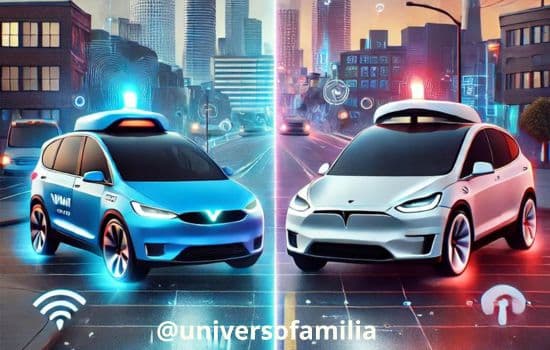
Who's in the Lead?
The answer to this question depends on the criteria used to measure success.
In terms of pure technology and safety, Waymo can be considered the leader, especially with its advanced use of LiDAR and its autonomous taxi operations in US cities.
However, Tesla is widely recognized for its innovative approach and ability to quickly deploy software updates to improve the autonomous functionality of its vehicles.
Links for More Information
Conclusion
Both Waymo and Tesla are pushing the frontier of autonomous vehicle technology, but with different approaches and strategies.
Waymo focuses on safety and accuracy with its use of LiDAR and autonomous taxis, while Tesla focuses on efficiency and scalability with cameras and radars integrated into consumer vehicles.
Ultimately, who wins this battle is still up for grabs, but the continued advancements of both companies promise an exciting future for autonomous mobility.
Share this article with your friends so everyone can learn more about this fascinating tech competition!